
Understanding Browser Storage Mechanisms
Browser storage mechanisms, such as cookies, local storage, and session storage, are fundamental technologies that enable modern websites and web applications to function effectively. Cookies are small text files placed on your device by a website you visit. They are designed to hold a modest amount of data specific to a particular client and website, and can be accessed either by the web server or the client computer.
This allows the server to deliver a page tailored to a particular user, or the page itself can contain some script which is aware of the data in the cookie and so can carry information from one visit to the website to the next. Beyond traditional cookies, modern browsers offer more robust client-side storage options like Web Storage (which includes local storage and session storage).
Local storage can retain data in your browser after a window is closed. Session storage is limited to the active browser session and is normally cleared when the relevant tab or window closes. Browser limits and behavior may vary.
How AiRep24 Employs Cookies and Local Storage
AiRep24's approach to using browser storage is guided by a commitment to enhancing service functionality, optimizing user experience, and ensuring privacy. We categorize our use of cookies and local storage into three primary areas: essential functionality, preference retention, and analytical insights. Each category serves a specific purpose, designed to make your interactions with our AI customer assistant as effective and intuitive as possible.
Our principle is to collect and utilize data only when it is necessary for the defined purpose. This means we avoid unnecessary data accumulation and focus on specific, actionable information that directly contributes to the performance and utility of the AiRep24 service. Our aim is to provide a robust and responsive AI assistant without compromising on user privacy or data security. In practice, this allows the AiRep24 assistant to adapt to your needs.
For example, browser storage may preserve interface or conversation state when you move between pages, subject to the active configuration and your browser settings.
For the related decision, see Automated Knowledge Base.

Enhancing User Experience Through Preferences
AiRep24 also uses persistent cookies and local storage to remember your preferences and settings, which significantly enhances your user experience over multiple visits. These items allow the AI assistant to adapt to your specific choices and past interactions, eliminating the need to repeatedly configure settings or provide redundant information.
Examples of preferences that might be stored include your chosen language for the AI assistant interface, whether you prefer the chat widget to be minimized or open by default, or the last topic you were discussing. By remembering these details, AiRep24 ensures that each subsequent interaction feels more personalized and efficient, picking up where you left off rather than starting from scratch. This capability is particularly beneficial for creating a streamlined customer journey.
When the AI assistant can recall previous context or preferences, it can provide more relevant and targeted assistance from the outset, saving you time and effort. It allows the AI to offer a more fluid and intelligent interaction, contributing to a better overall service experience.
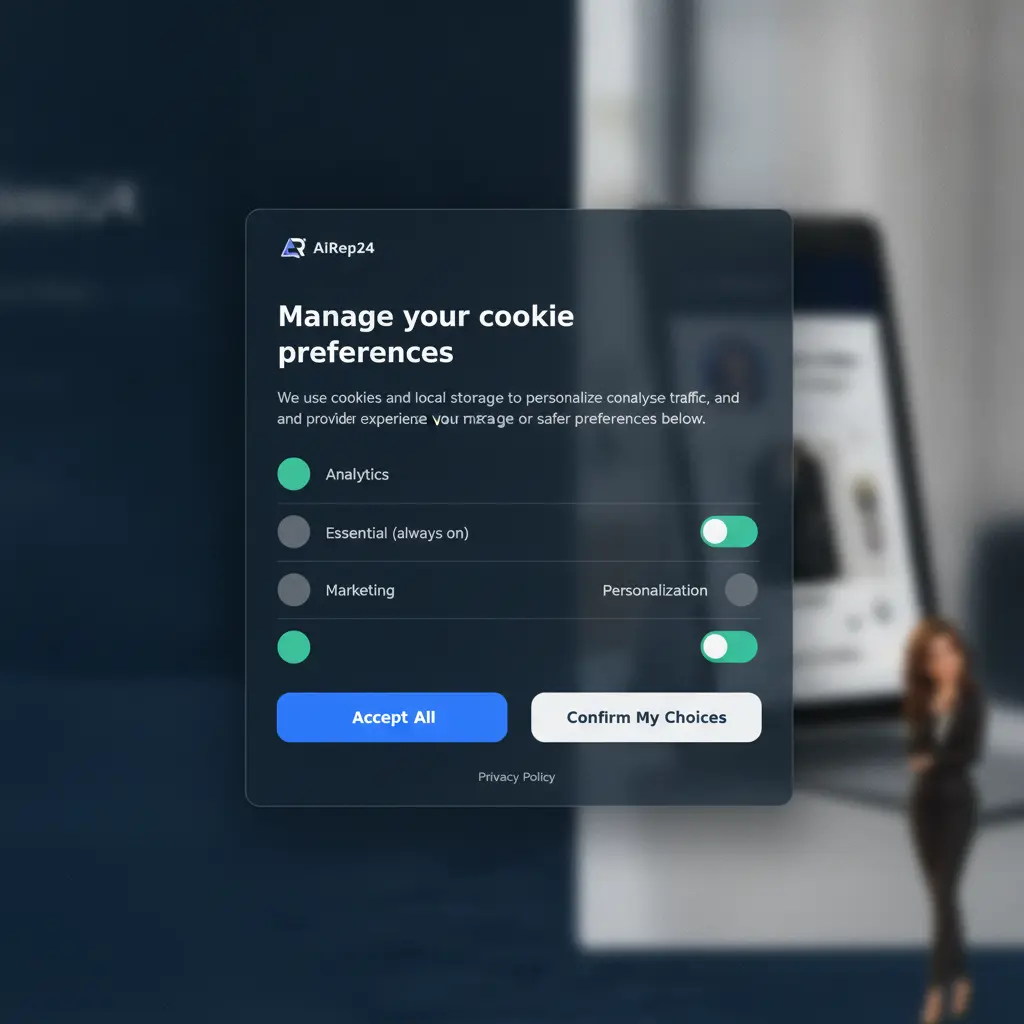
Analytics for Continuous Service Improvement
To continually improve the performance and utility of the AiRep24 assistant, we utilize analytical cookies and similar technologies. These tools collect aggregated and anonymized data about how users interact with the assistant and the website where it is deployed. This data helps us understand general usage patterns, identify popular queries, and assess the effectiveness of the AI's responses. The purpose of this analytical data is purely for service optimization.
For instance, by observing common navigation paths or frequently asked questions, we can refine the AI's knowledge base, improve its conversational flows, and identify areas where additional information or clarity might be needed. This process is instrumental in making the AiRep24 assistant more intelligent and helpful over time. It is important to emphasize that all analytical data collected is anonymized. This means that the information gathered cannot be linked back to individual users.
Where analytics is enabled, AiRep24 uses the collected information for service operation, security, troubleshooting, and aggregate product analysis as described in the privacy policy.
Managing Your Browser Storage Preferences
You have control over the cookies and local storage items stored on your device. Most web browsers provide settings that allow you to manage your preferences, including the ability to delete existing items, block all cookies, block third-party cookies, or receive a notification before a cookie is stored. This empowers you to make informed decisions about your online privacy. It is important to understand the potential impact of disabling certain types of browser storage.
While blocking analytical cookies typically won't affect the core functionality of the AiRep24 assistant, disabling essential or preference-related cookies might lead to a degraded user experience. For example, the AI assistant might not be able to remember your conversation history, language preference, or widget state, requiring you to start fresh with each new interaction.
To manage cookies and local storage, use the privacy or site-data settings in your browser. The available controls and deletion steps differ between Chrome, Firefox, Safari, Edge, and other browsers.

Third-Party Services and Data Handling
This AiRep24 Cookie and Local Storage Policy specifically addresses the use of browser storage by the AiRep24 service itself. Websites where AiRep24 is deployed often integrate various other third-party services, such as marketing platforms, analytics providers, social media plugins, or advertising networks. These external services may also set their own cookies or utilize local storage on your device.
It is crucial to understand that the collection and use of data by these other third-party services are governed by their respective privacy and cookie policies, not by AiRep24's policy. While AiRep24 is designed to operate with a focus on user privacy, we do not control the practices of other services that a website owner chooses to integrate.
Therefore, we strongly advise users to review the privacy and cookie policies of any specific website they visit, particularly when interacting with features or content provided by third parties. Being informed about how different services handle your data is an important step in managing your online privacy comprehensively.
For the related decision, see Explore AiRep24 implementation insights.
Policy Updates and Transparency
The digital landscape, including technologies for browser storage and data privacy regulations, is constantly evolving. As such, AiRep24 periodically reviews and may update this Cookie and Local Storage Policy to reflect changes in our service, technology, or legal requirements. Our commitment is to maintain full transparency regarding our data handling practices. Any revisions to this policy will be posted on this page, accompanied by an updated 'Effective Date'.
For significant changes that might materially impact how your data is handled or how the AiRep24 service operates in relation to browser storage, we may provide additional notification through our website or service interface to ensure you are well-informed.
AiRep24 may update this notice when storage practices, product behavior, or legal requirements change. The current version and effective date are published on this page.